


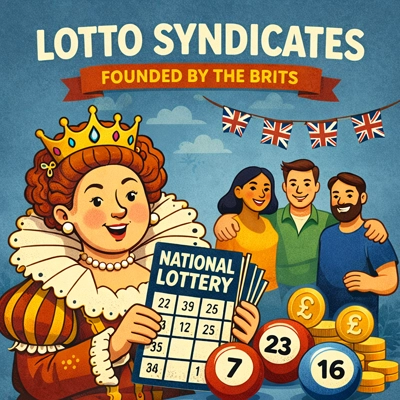
Lottery Syndicates: Founded by The Brits - A Complete Guide
What is a Lottery Syndicate? (Quick Overview)
A lottery syndicate is a group of people who pool their money to buy multiple lottery tickets together and share any winnings. By playing as a group, you get more chances to win without spending a fortune individually. Syndicates can be organised informally with friends, family, or colleagues—or you can join ready-made online syndicates with strangers through licensed platforms like LottoGo or Jackpot.com.
Key facts:
- Syndicates were invented in England in the 18th century
- Around 1 in 5 top National Lottery prizes are won by syndicates
- The odds per ticket stay the same, but more tickets mean more chances to win
- Winnings are split equally (or as agreed) between all members
- Always use UKGC-licensed sites when playing online
Related Pages
When Lotto Syndicates was founded by the Brits
A Game as Old as Civilisation
The National Lottery has been around since I was 11. Now I'm 42, so that's more than 30 years of Wednesday and Saturday night draws, rollover jackpots, and those "it could be you" dreams. For my generation, it's always been part of life. I've only won a few tenners so far, but I'm still hoping for that big win.
But while the UK's lottery feels modern, the idea itself is ancient. It goes back more than two thousand years.
The Roman Emperor Augustus established one of the earliest recorded state lotteries, using the proceeds to repair the City of Rome. It was a smart way to leverage people's love of gambling to fund new roads and buildings.
By the 1400s, towns in what is now Belgium and the Netherlands were running public lotteries to pay for town walls and help the poor. With tickets, prizes, and official rules, these were the first lotteries that would seem familiar to us today.
Over a hundred years later, France was next. King Francis I started the Loterie Royale in 1539 after seeing its success in Italy.
And in our own country, England, Queen Elizabeth I joined in 1566, and the first draw in 1569 raised money for ports and public works.
So next time you pick your numbers, remember that you're joining a tradition that goes back centuries.
The Birth of the Syndicate: An English Innovation
Here's a fun fact that might surprise you: while we Brits didn't invent the lottery, lottery syndicates were invented in England.
I actually thought it was America; it just feels bigger than the UK. So it got me asking... why England and not America? And apparently, it comes down to economics. When state lotteries started in England in the 1690s, tickets were very expensive for most people. In the early 1700s, a single ticket could cost about half of a typical yearly income.
The answer was simple: if you couldn't afford a whole ticket, you could buy a share. People started joining together, pooling their money to buy tickets as a group and agreeing to split any winnings. That's how the lottery syndicate began.
By 1798, the idea had shown its value. Four low-paid workers—a female servant from Holborn, a servant of the Duke of Roxburgh, a fruit stall keeper, and a vegetable carrier from Covent Garden—shared a winning ticket worth £20,000 (about £1.2 million today). Playing together could really change lives.
Historical records show that the first organised ticket-sharing groups and syndicate wins started in 18th-century Britain. The idea later spread to the United States, where public lotteries became common.
From Pen and Paper to the Digital Age
Jump ahead two centuries, and the lottery moved online, starting in a small Alpine country you might not expect.
On 7 October 1995, in the Köfferli bar in Vaduz, Liechtenstein, history was made. The International Lottery in Liechtenstein Foundation launched "Interlotto" (later called PLUS Lotto), the first online lottery, and processed the first-ever online gaming transaction. The first ticket went to Mario Frick, the Prime Minister of Liechtenstein, and Caroline Burdet, the country's first Olympic bobsledder, drew the winning numbers in what became the first nationally approved online lottery.
For national lotteries, the UK's Camelot-run National Lottery was quick to go digital, adding official online ticket sales in the early 2000s. Although we were the first to found syndicates, we were behind the times even back then, as it was still several years after Liechtenstein's groundbreaking launch in 1995.
Today, syndicates have gone from scribbled lists in pub notebooks to fully managed online pools. In the UK, group play regularly accounts for a significant chunk of top-tier wins across Lotto, EuroMillions, and EuroMillions UK Millionaire Maker, with some operator stats putting syndicates at roughly 1 in 5 of the biggest prizes.
What started in 18th-century English taverns and coffee houses has become a global way to play: people on different sides of the world now share tickets, jackpots, and those "it could be us" moments without ever meeting in person.
Why Do People Play Lottery Syndicates?
Let's be honest about the odds
The chances of winning the dream lottery jackpot are terrible. There's no nice way to say it.
The UK Lotto? 1 in 45 million. EuroMillions? 1 in 140 million. You're genuinely more likely to be struck by lightning—twice—than to match all six numbers on a Saturday night. Yet, we still like to play because, just maybe one day, "it could be you!"... someone has to win it.
It wasn't always this bad. Before 2015, when the UK Lotto only had 49 balls, your odds were about 1 in 14 million. Still rubbish, but nearly three times better than now. Then they added ten more balls to create bigger rollover jackpots, and the odds went through the floor. Interestingly, the Irish Lotto still uses a smaller pool, 47 balls instead of 59, which means jackpot odds of about 1 in 10.7 million. That's over four times better than the UK Lotto. You can't play it directly from the UK, but you can bet on the results through bookmakers like Betfred and LottoGo UK. Just be aware there's usually a payout cap (often around £500,000 to £1 million) if you're betting rather than buying an actual ticket. Something to think about if your syndicate fancies better odds.
So why do millions of us still play, knowing the numbers are stacked against us?
Hope, mostly. That little "what if" that keeps you checking your ticket. The daydream of handing in your notice, paying off the mortgage, and buying your mum a house.
And that's exactly where syndicates come in.
More tickets, better odds
The maths is simple. If you buy one ticket, you've got one chance. If your syndicate buys 50 tickets, you've got 50 chances. Yes, you'll split any winnings, but being 50 times more likely to win something? That's a trade-off most people are happy to make.
It doesn't make those 1 in 45 million odds good, but it makes them better. And when you're playing for fun rather than as a retirement plan, better is enough.
It's cheaper to dream bigger
A tenner a month into a work syndicate might get you shares in 40 or 50 lines across multiple draws. Try buying that many tickets yourself every week, and you'd be skint by the next month.
Syndicates let you play more for less. You're pooling your buying power, exactly like those 18th-century workers who couldn't afford a whole ticket on their own.
The social side
There's something about checking the numbers together. The group chat on WhatsApp or Facebook lighting up on a Saturday night. The office on Monday morning, when you've matched three numbers and everyone's calculating what their share would have been.
For many people, it's not really about the money at all; it's the shared excitement. The collective daydream of "what would we all do if we won?"
A win is still a win
Here's the thing people forget: even split 10 ways in a syndicate, a decent prize is life-changing. £100,000 between ten people is still £10,000 each. That's a new car, a house deposit, a holiday of a lifetime.
Nobody's complaining about that.
And don't forget—the jackpot isn't the only prize. Your overall odds of winning something on the UK Lotto are about 1 in 10. Match two numbers, and you get a free Lucky Dip. Match three, and you're looking at £30. It's not retirement money, but it's a round in the pub.
Workplace Syndicates - Still going strong
You might think workplace lottery syndicates are a bit old-fashioned, something from the 90s when Anthea Turner was doing the National Lottery draws, and everyone gathered round the telly on a Saturday night.
But they're still everywhere.
There are thousands of workplace syndicates running in the UK right now. Most are informal—a group of colleagues chipping in a few quid each week, someone keeping a list in a desk drawer, numbers checked on a Monday morning over a brew.
And here's a stat that might make you want to start one: around a quarter of National Lottery jackpot wins go to syndicates, and a huge chunk of those are work-based groups. That's real money going to real offices across the country.
The setup hasn't changed in decades. One person becomes the "manager." They collect the money, buy the tickets, check the numbers, and share the results. Some groups have gone digital, online National Lottery accounts, apps to track who's paid, WhatsApp groups pinging every draw night. But the basic idea? Exactly the same as those 18th-century workers pooling their wages for a share of an expensive ticket.
And it's not just workplaces. Syndicates with friends, family, or down the pub are just as popular. Maybe you've got a group of mates who've been playing the same numbers for years. Or a family WhatsApp where your nan insists on her "lucky" numbers every week.
It all counts. It's all part of the same tradition.
The Big Wins: Proof That Syndicates Actually Work
It's easy to think "nobody ever really wins on the Lotto Syndicates." But they do. And syndicates punch well above their weight.
Here are some of the biggest UK syndicate wins on record: real people, real offices, real families walking away with life-changing money.
£61.1 million – A family syndicate, Monmouth (2016)
Five family members shared a £61.1 million EuroMillions jackpot on 29 July 2016. That's over £12 million each, for a family who'd been playing together for years. One of the largest syndicate wins in UK history, and it stayed in the family.
£45.5 million – The "Magnificent Seven," Merseyside (2009)
Seven office workers split a £91 million EuroMillions jackpot in November 2009. Their share? £45.5 million between them, roughly £6.5 million per person. They'd been chipping in together for years. One week, their numbers came up. Imagine that Monday morning in the office.
£25.4 million – The "Catering Girls," Neath Port Talbot (2017)
Six kitchen workers from Neath Port Talbot Hospital banked a £25.4 million EuroMillions jackpot in November 2017. Every member instantly became £4.2 million richer, and they all decided to retire on the spot. Plans included trips to Florida and Las Vegas, new cars, and homes fit for millionaires.
£18.2 million – Tesco staff, Driffield (2005)
An 11-strong syndicate of Tesco workers shared £18.2 million on the Lotto. Most walked away with about £1.4 million each. Two members who'd taken double shares got roughly £2.8 million.
All from stacking shelves and putting a few quid into the office pot each week.
£10 million – Camden Council workers (1996)
This one's from the early days of the National Lottery—33 council workers splitting £10 million. That's about £303,000 each. Not billions, but enough to clear the mortgage, buy a new car, and have a very comfortable cushion.
Thirty-three people. Probably started with someone saying, "Fancy going in on the lottery?" in a break room.
Online syndicates and platforms are producing winners, too!
Think you need to be handing over cash in a staff room to win big? Not anymore—isn't everyone using digital wallets now?
A syndicate formed on Facebook won £1.1 million on the EuroMillions back in 2015, proof that online groups can hit the jackpot just like traditional ones.
And in June 2025, the "West is Best Syndicate"—16 players, many of whom had never met in person—shared a £3.6 million EuroMillions prize. It started with a few colleagues at Bridgend Council. When the organiser moved jobs, she kept it going by recruiting new members through Facebook: old friends, family, even her former rugby coach. Each member took home just over £212,000.
Online lottery betting sites are paying out big sums, too. In 2024, LottoGo UK handed £6 million to Linda, a 61-year-old from Surrey, who'd been subscribing to the Spanish El Gordo lottery for years so she'd never miss a draw. Celebrity chef Ainsley Harriott turned up with the cheque and a bottle of fizz. They've also paid out over £800,000 to a Powerball player and multiple six-figure wins on EuroMillions bets.
Whether you're meeting at the photocopier, connecting through a group chat, or buying shares on a betting site, the formula's the same: more tickets, more chances, shared dreams.
Which brings us to how you actually get started.
How to Play: From Paper Slips to Online Shares
For years, most syndicates were strictly offline. Someone at work or down the pub collected a few quid, nipped to the local shop, and kept a handwritten list of who was in that weekly draw. Maybe there was a Quality Street tin with the cash in it. Maybe Linda from accounts had a spreadsheet. Maybe it was just a scribbled note on the back of an envelope.
The idea hasn't changed, but how you run a syndicate has.
Today, you've got two main options: do it the old-school way with physical tickets, queuing up in your local paper shop, or run everything online.
Option 1: Old-school, shop-bought tickets
This is how your parents probably did it and how plenty of offices still do it now.
One person—the manager—collects money from everyone in the group. Cash in hand, bank transfer, whatever works. They head to the newsagent's, fill in the slips, and buy the tickets.
The "contract" is usually informal: a photo of the tickets sent to the group chat, a handwritten list of who paid that week, maybe a WhatsApp message confirming everyone's in. It's not fancy, but it's worked for decades.
The upside? It's simple. Everyone understands it. There's something satisfying about holding a physical ticket.
The downside? It relies heavily on one person. If they're off sick, on holiday, or just forget, no tickets get bought. And if there's ever a dispute about who paid or who was in that group, they use a licensed lottery site like LottoGo, and buy lines on behalf of the group. Everyone gets screenshots or email confirmations of the entries. Stakes are tracked by bank transfer, standing order, or e-wallet, rather than coins in a mug on someone's desk.
Option 2: Digitalised Syndicates and World Wide Lotteries
One big advantage? Choice. You're not limited to the UK Lotto and EuroMillions. Online platforms open up international lotteries: the Irish Lotto with its better odds, the massive US Powerball and Mega Millions jackpots, and the Spanish El Gordo. Yes, your local bookies offer some of these too, but not everyone fancies walking into a betting shop to play the lottery. Online feels different somehow.
It's tidier. There's a digital paper trail. Nobody has to remember to pop to the shop before the 7:30pm cut-off.
And here's the thing—you don't even need to know anyone. If you haven't got colleagues or mates who fancy playing, you can join an existing online syndicate with complete strangers. You're just buying shares in a group, splitting the cost of more tickets, and sharing any winnings. You'll never meet them, probably never even know their names, but you're all in it together.
Some dedicated syndicate platforms handle everything for you: tickets, number selection, splitting, and payouts. You don't need a manager. You don't need to chase anyone for their fiver. It's all automated.
The syndicate hasn't changed—just the tools
Whether you're handing over a crumpled tenner in the staff room or setting up a monthly direct debit to an online platform, the core idea is identical: people pooling stakes and sharing prizes.
Your nan's syndicate from 1995 and a slick app-based group in 2025 are doing exactly the same thing. One just involves less queueing at the Post Office.
And that's where online syndicate platforms come in.
How Online Lottery Sites Work
The National Lottery (official site or app)
This works exactly how you'd expect. You're buying real tickets. If your numbers come up, the lottery operator pays you. Tax-free, straightforward.
Want to run a syndicate? You organise it yourself—rope in friends, family, or workmates, set up a group account, and sort out the splits between you. Same as the paper ticket method, just without the trip to the newsagent.
Other online sites (LottoGo, Lottoland, etc.)
These work differently. They mostly offer global lotteries—US Powerball, Mega Millions, Irish Lotto, and Spanish El Gordo—games you can't buy tickets for in your local shop.
Here's the key thing: you're not actually entering the foreign lottery directly. You're betting on the outcome of the draw. If your numbers come up, the UK-licensed site pays you, not the American or Spanish lottery company. They cover big wins through insurance. Still tax-free under UK gambling rules.
And this is where ready-made syndicates come in. You don't need to organise anything or know anyone. The site offers syndicates you can simply buy shares in alongside complete strangers. They pool everyone's stakes, buy more lines, and split any winnings automatically.
Staying safe: check the licence
The National Lottery is regulated by the UK Gambling Commission (UKGC), and so are legitimate lottery betting sites. But not every site you stumble across online will be.
Before you fund any online lotto account, check that the operator is properly licensed. You can search the UKGC public register at gamblingcommission.gov.uk to verify any site. If they're not on there, don't play with them. Simple as that.
A licensed site means your money is protected, payouts are guaranteed, and there's somewhere to complain if things go wrong.
A simple guide to joining an online syndicate
- Choose a reputable platform – Read reviews and check its licensing status on the UKGC public register.
- Create an account – Provide your email address and set up a secure password.
- Browse the syndicate options – Pick a group that suits your budget and how you want shares and prizes split.
- Purchase your share – Pay your stake via secure methods like a debit card or a digital wallet.
- Get confirmation – You'll receive details of your participation and the syndicate you've joined.
- Wait for the draw – The platform notifies you of any winnings and automatically handles prize distribution.
No chasing colleagues for fivers. No spreadsheets. No arguments about who was in that week.
Where to Play: Your Main Options
So if you want to join an online syndicate, where do you actually go?
It depends on what you're after. Some sites offer ready-made syndicates you can join with strangers. Others let you bet on lottery outcomes, but you'd need to organise your own syndicate with mates.
LottoGo
One of the easiest options for managed syndicates. LottoGo UK offer ready-made syndicate shares for EuroMillions, Powerball, Mega Millions, and other international draws. You buy a share, they handle the tickets, entries, and payouts. No organising, no chasing anyone for money.
Jackpot.com
Similar setup—managed syndicates you can join with strangers. Their UK Lotto syndicate, for example, gives you a share in 28 lines for £2.99. If the syndicate wins, prizes are split equally between shareholders. They also run syndicates for EuroMillions and various global lotteries.
Both platforms take care of everything. You just pick your syndicate, buy your shares, and wait for the draw.
Betfred and Ladbrokes
Big, trusted bookmakers Betfred and Ladbrokes have been around for decades. Both offer lotto betting on international draws: Irish Lotto, 49s, New York Lotto, Daily Million, Spanish, French, and more.
But here's the difference: they don't run managed syndicates with strangers. You're betting on your own numbers at fixed odds. If you want to play as a syndicate, you'd need to organise it yourself—get some mates together, pool your stakes, and manage the splits between you.
Still solid if you've got a group and want access to global lotteries. Just don't expect the platform to match you with other players.
Quick comparison
| Site | Managed syndicates with strangers? | Lotto betting on global draws? | Need to organise your own group? |
|---|---|---|---|
| LottoGo | Yes | Yes | No |
| Jackpot.com | Yes | Yes | No |
| Betfred | No | Yes | Yes |
| Ladbrokes | No | Yes | Yes |
All four are licensed by the UK Gambling Commission, so your money's protected and payouts are guaranteed. Just pick the one that fits how you want to play.
Wrapping Up: Is a Lotto Syndicate Right for You?
In the end, syndicates are just a smarter way of doing what millions of us already do: chuck a few quid at a long-shot dream and see what happens, with other people in on the laugh. Whether you're passing a crumpled tenner across a desk or buying shares in a slick online pool, the trade-off is always the same: slightly smaller slices, much better chances that there'll be something to slice. Like bingo, lotto is part of British culture; after all, syndicates started right here in the UK.
If you fancy giving it a go, start simple. Grab a couple of mates, agree on the rules, and try a few weeks on Lotto or EuroMillions. Once you're comfortable with how it works, you can decide whether to keep it old-school with paper tickets, move everything into an online National Lottery account, or stick with a managed syndicate on a site like LottoGo or Jackpot.com. Or if you're like me—a bit slim on work friends because you're self-employed—then you can get started straight away by joining a site with online syndication and play alongside strangers instead.
Whichever route you choose, set a budget, treat it as entertainment, and remember: it's supposed to be fun first, and a bonus if the numbers ever actually drop in your favour. Always play responsibly.
Syndicates won't magically beat the odds, but they will give you more chances to enjoy the ride—and, every now and then, they really do turn "it could be us" into "it was us."
Lotto Basics FAQs
- What exactly is a lottery syndicate?
A syndicate is simply a group of people who play lottery tickets together. When the syndicate wins, the prize is shared between everyone in the group. It's been done this way since the 1700s—only the tools have changed.
- What are the first steps if I want to join a syndicate today?
If you've got mates or colleagues up for it: ask around, agree on a small weekly stake (£2–£5 is common), pick someone to manage it, and buy your first tickets this weekend. Keep it simple to start.
If you're going solo: sign up to a site like LottoGo or Jackpot.com, pick a syndicate that suits your budget, buy a share, and you're in. Takes about five minutes.
- How do I set up a syndicate with friends or family?
Start small:
- Decide who's in—keep it manageable at first (5–10 people works well)
- Choose a "manager" to collect money and buy tickets
- Agree how much everyone pays and how often (weekly or monthly)
- Decide how winnings will be split—usually equal shares
- Write it down—the National Lottery offers a free syndicate agreement template on their website
- Share photos of tickets or confirmations with the group after each purchase
- How much does it cost to join or run a syndicate?
It varies. A typical workplace syndicate might be £5–£10 per month. Online managed syndicates like those on LottoGo or Jackpot.com start from around £2–£3 per share. You're essentially splitting the cost of bulk ticket purchases, so the more people in the group, the cheaper it is per person—but the smaller your share of any win.
- How are Syndicate payments managed?
For DIY syndicates: the manager collects money via cash, bank transfer, or standing order before buying tickets. Many groups use a shared spreadsheet or WhatsApp to track who's paid.
For online syndicates: you pay directly through the platform by debit card or e-wallet. No chasing anyone—it's all automated.
- What are the main risks or pitfalls to avoid?
- No written agreement – the number one cause of syndicate fallouts. Even a quick group message everyone confirms is better than nothing.
- Trusting one person with everything – make sure tickets or confirmations are shared with the group, not just kept by the manager.
- Unlicensed websites – if a site isn't on the UKGC register, don't use it. Full stop.
- Overspending – set a budget and stick to it. Syndicates are meant to be fun, not a financial strain.
- Unclear rules on leavers – decide upfront what happens if someone wants out or misses a payment.
- What happens if someone forgets to pay or there's a disagreement?
This is why a written agreement matters. Set clear rules upfront:
- If you don't pay, you're not in that week's draw
- No exceptions, no IOUs
- Keep records of every payment and every ticket purchased
Most disputes happen when there's no paper trail. A simple agreement—even just a group message everyone acknowledges—can prevent arguments later. The National Lottery's free template covers all the basics.
- How are disputes typically resolved?
For DIY syndicates: it usually comes down to your written agreement. If you've got clear rules on payments, shares, and what happens if someone drops out, most disputes resolve themselves. If not, it can get messy—and in extreme cases, legal. That's why even an informal agreement matters.
For online syndicates: disputes are rare because the platform handles everything automatically. If there's an issue with payouts or your account, you'd go through the site's customer support. Licensed sites are required to have a complaints process.
- Are there hidden fees with managed online syndicates?
Reputable sites are upfront about costs—you pay per share, and that's it. But always read the terms. Some platforms take a small cut of winnings, others build their margin into the share price. Check before you commit. If the fee structure isn't clear, that's a red flag.
- How are winnings distributed?
For DIY syndicates: the prize goes to whoever holds the winning ticket (usually the manager). They're then responsible for splitting it according to your agreement.
For online syndicates: the platform splits winnings automatically and pays each shareholder directly into their account.
- How easy is it to leave a syndicate or withdraw winnings?
For DIY syndicates: you can leave whenever you like—just tell the group. Any winnings owed to you should be paid out based on your agreement. Give reasonable notice so the manager can adjust numbers.
For online syndicates: you can usually stop buying shares at any time—there's no lock-in. Withdrawing winnings is typically straightforward: request a payout to your bank or e-wallet. Most licensed sites process withdrawals within a few days, though some have minimum withdrawal amounts.

GlitzyBingo.co.uk publishes independent UK lotto guides designed to explain how lotto betting works (registration, verification, site structure, and key operator details).
This guide is for informational purposes only. Always confirm current terms, safer gambling tools, and licensing details on the operator’s official website before depositing.